 Add to Chrome
 Add to Firefox
 Add to Edge
Score-Control for Hallucination Reduction in Diffusion Models
May 29, 2026
Diffusion models have emerged as the backbone of modern generative AI, powering advances in vision, language, audio and other modalities. Despite their success, they suffer from hallucinations, implausible samples that lie outside the support of true data distribution, which degrade reliability and trust. In this work, we first empirically confirm previously proposed hypothesis that score smoothness causes hallucinations in Image Generation diffusion models and provide a density-based perspective. We further formalize this notion by linking the hallucinations probability mass to lipschitz constant of the learned score function. Motivated by this, we introduce a Variance-Guided Score Modulation (VSM) strategy that controls the score Jacobian, in turn reducing score smoothness and better approximating the ground truth score that decreases hallucinations. Empirical results on synthetic and real-world datasets demonstrate that our approach reduces hallucinations (up to ~25%) while maintaining high fidelity and diversity, providing a principled step toward more reliable diffusion-based image generation. We also propose two benchmark datasets with extreme semantic variation for systematic hallucination evaluation. Code and Datasets are publicly available at https://github.com/bhosalems/VSM.

CRAFT: Critic-Refined Adaptive Key-Frame Targeting for Multimodal Video Question Answering
May 18, 2026Grounded multi-video question answering over real-world news events requires systems to surface query-relevant evidence across heterogeneous video archives while attributing every claim to its supporting source. We introduce CRAFT (Critic-Refined Adaptive Key-Frame Targeting), a query-conditioned pipeline that combines dynamic keyframe selection, per-video ASR with multilingual fallback, and a hybrid critic loop to iteratively verify and repair claims before consolidation. The pipeline integrates UNLI temporal entailment, DeBERTa-v3 cross-claim screening, and a Llama-3.2-3B adjudicator, with a final citation-merging stage that emits each fact once with all supporting source identifiers. On MAGMaR 2026, CRAFT achieves the best overall average (0.739), reference recall (0.810), and citation F1 (0.635). We further evaluate on a MAGMaR-style conversion of WikiVideo with 52 non-overlapping event queries, where CRAFT also performs strongly (0.823 Avg), showing that its claim-centric evidence aggregation generalizes beyond MAGMaR. Ablations show that atomic claims, ASR, and the critic loop drive the main gains over the vanilla query-conditioned baseline. Code and implementation details are publicly available at https://github.com/bhosalems/CRAFT.
CWCD: Category-Wise Contrastive Decoding for Structured Medical Report Generation
Apr 12, 2026Interpreting chest X-rays is inherently challenging due to the overlap between anatomical structures and the subtle presentation of many clinically significant pathologies, making accurate diagnosis time-consuming even for experienced radiologists. Recent radiology-focused foundation models, such as LLaVA-Rad and Maira-2, have positioned multi-modal large language models (MLLMs) at the forefront of automated radiology report generation (RRG). However, despite these advances, current foundation models generate reports in a single forward pass. This decoding strategy diminishes attention to visual tokens and increases reliance on language priors as generation proceeds, which in turn introduces spurious pathology co-occurrences in the generated reports. To mitigate these limitations, we propose Category-Wise Contrastive Decoding (CWCD), a novel and modular framework designed to enhance structured radiology report generation (SRRG). Our approach introduces category-specific parameterization and generates category-wise reports by contrasting normal X-rays with masked X-rays using category-specific visual prompts. Experimental results demonstrate that CWCD consistently outperforms baseline methods across both clinical efficacy and natural language generation metrics. An ablation study further elucidates the contribution of each architectural component to overall performance.
FairLLaVA: Fairness-Aware Parameter-Efficient Fine-Tuning for Large Vision-Language Assistants
Mar 27, 2026While powerful in image-conditioned generation, multimodal large language models (MLLMs) can display uneven performance across demographic groups, highlighting fairness risks. In safety-critical clinical settings, such disparities risk producing unequal diagnostic narratives and eroding trust in AI-assisted decision-making. While fairness has been studied extensively in vision-only and language-only models, its impact on MLLMs remains largely underexplored. To address these biases, we introduce FairLLaVA, a parameter-efficient fine-tuning method that mitigates group disparities in visual instruction tuning without compromising overall performance. By minimizing the mutual information between target attributes, FairLLaVA regularizes the model's representations to be demographic-invariant. The method can be incorporated as a lightweight plug-in, maintaining efficiency with low-rank adapter fine-tuning, and provides an architecture-agnostic approach to fair visual instruction following. Extensive experiments on large-scale chest radiology report generation and dermoscopy visual question answering benchmarks show that FairLLaVA consistently reduces inter-group disparities while improving both equity-scaled clinical performance and natural language generation quality across diverse medical imaging modalities. Code can be accessed at https://github.com/bhosalems/FairLLaVA.
Kirchhoff-Inspired Neural Networks for Evolving High-Order Perception
Mar 25, 2026Deep learning architectures are fundamentally inspired by neuroscience, particularly the structure of the brain's sensory pathways, and have achieved remarkable success in learning informative data representations. Although these architectures mimic the communication mechanisms of biological neurons, their strategies for information encoding and transmission are fundamentally distinct. Biological systems depend on dynamic fluctuations in membrane potential; by contrast, conventional deep networks optimize weights and biases by adjusting the strengths of inter-neural connections, lacking a systematic mechanism to jointly characterize the interplay among signal intensity, coupling structure, and state evolution. To tackle this limitation, we propose the Kirchhoff-Inspired Neural Network (KINN), a state-variable-based network architecture constructed based on Kirchhoff's current law. KINN derives numerically stable state updates from fundamental ordinary differential equations, enabling the explicit decoupling and encoding of higher-order evolutionary components within a single layer while preserving physical consistency, interpretability, and end-to-end trainability. Extensive experiments on partial differential equation (PDE) solving and ImageNet image classification validate that KINN outperforms state-of-the-art existing methods.
Accelerating Social Science Research via Agentic Hypothesization and Experimentation
Feb 08, 2026Data-driven social science research is inherently slow, relying on iterative cycles of observation, hypothesis generation, and experimental validation. While recent data-driven methods promise to accelerate parts of this process, they largely fail to support end-to-end scientific discovery. To address this gap, we introduce EXPERIGEN, an agentic framework that operationalizes end-to-end discovery through a Bayesian optimization inspired two-phase search, in which a Generator proposes candidate hypotheses and an Experimenter evaluates them empirically. Across multiple domains, EXPERIGEN consistently discovers 2-4x more statistically significant hypotheses that are 7-17 percent more predictive than prior approaches, and naturally extends to complex data regimes including multimodal and relational datasets. Beyond statistical performance, hypotheses must be novel, empirically grounded, and actionable to drive real scientific progress. To evaluate these qualities, we conduct an expert review of machine-generated hypotheses, collecting feedback from senior faculty. Among 25 reviewed hypotheses, 88 percent were rated moderately or strongly novel, 70 percent were deemed impactful and worth pursuing, and most demonstrated rigor comparable to senior graduate-level research. Finally, recognizing that ultimate validation requires real-world evidence, we conduct the first A/B test of LLM-generated hypotheses, observing statistically significant results with p less than 1e-6 and a large effect size of 344 percent.
AutoEdit: Automatic Hyperparameter Tuning for Image Editing
Sep 18, 2025Recent advances in diffusion models have revolutionized text-guided image editing, yet existing editing methods face critical challenges in hyperparameter identification. To get the reasonable editing performance, these methods often require the user to brute-force tune multiple interdependent hyperparameters, such as inversion timesteps and attention modification, \textit{etc.} This process incurs high computational costs due to the huge hyperparameter search space. We consider searching optimal editing's hyperparameters as a sequential decision-making task within the diffusion denoising process. Specifically, we propose a reinforcement learning framework, which establishes a Markov Decision Process that dynamically adjusts hyperparameters across denoising steps, integrating editing objectives into a reward function. The method achieves time efficiency through proximal policy optimization while maintaining optimal hyperparameter configurations. Experiments demonstrate significant reduction in search time and computational overhead compared to existing brute-force approaches, advancing the practical deployment of a diffusion-based image editing framework in the real world.
On Measuring Intrinsic Causal Attributions in Deep Neural Networks
May 14, 2025Quantifying the causal influence of input features within neural networks has become a topic of increasing interest. Existing approaches typically assess direct, indirect, and total causal effects. This work treats NNs as structural causal models (SCMs) and extends our focus to include intrinsic causal contributions (ICC). We propose an identifiable generative post-hoc framework for quantifying ICC. We also draw a relationship between ICC and Sobol' indices. Our experiments on synthetic and real-world datasets demonstrate that ICC generates more intuitive and reliable explanations compared to existing global explanation techniques.
YOLOv12: Attention-Centric Real-Time Object Detectors
Feb 18, 2025Enhancing the network architecture of the YOLO framework has been crucial for a long time, but has focused on CNN-based improvements despite the proven superiority of attention mechanisms in modeling capabilities. This is because attention-based models cannot match the speed of CNN-based models. This paper proposes an attention-centric YOLO framework, namely YOLOv12, that matches the speed of previous CNN-based ones while harnessing the performance benefits of attention mechanisms. YOLOv12 surpasses all popular real-time object detectors in accuracy with competitive speed. For example, YOLOv12-N achieves 40.6% mAP with an inference latency of 1.64 ms on a T4 GPU, outperforming advanced YOLOv10-N / YOLOv11-N by 2.1%/1.2% mAP with a comparable speed. This advantage extends to other model scales. YOLOv12 also surpasses end-to-end real-time detectors that improve DETR, such as RT-DETR / RT-DETRv2: YOLOv12-S beats RT-DETR-R18 / RT-DETRv2-R18 while running 42% faster, using only 36% of the computation and 45% of the parameters. More comparisons are shown in Figure 1.
Personalized Large Vision-Language Models
Dec 23, 2024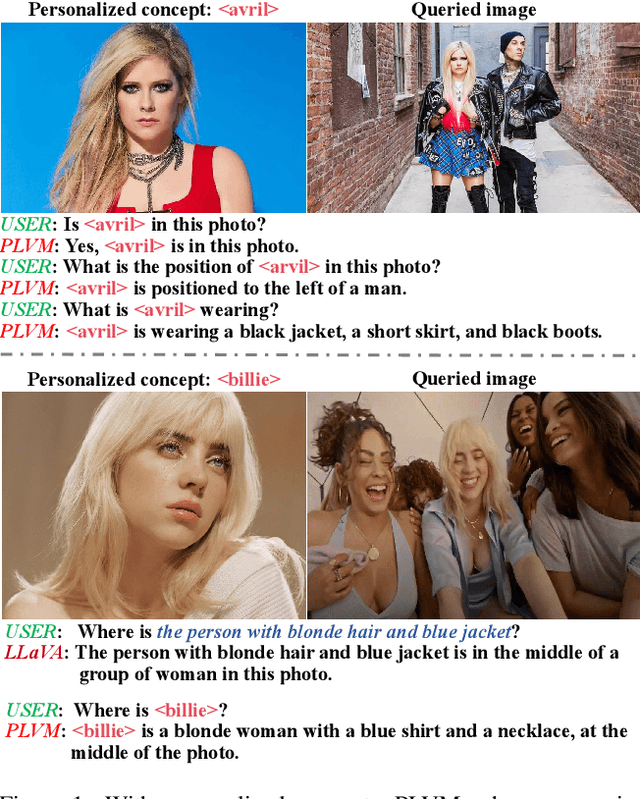
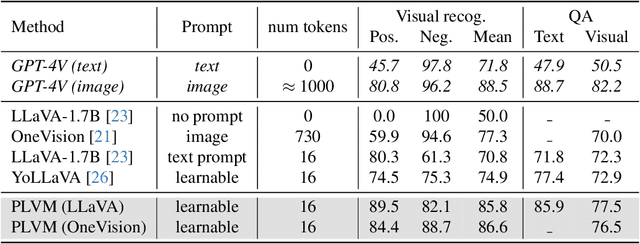
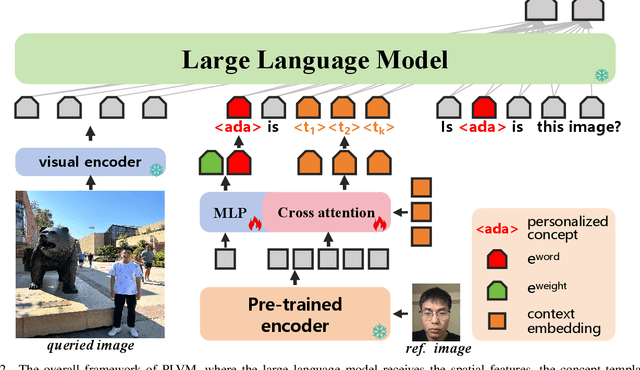

The personalization model has gained significant attention in image generation yet remains underexplored for large vision-language models (LVLMs). Beyond generic ones, with personalization, LVLMs handle interactive dialogues using referential concepts (e.g., ``Mike and Susan are talking.'') instead of the generic form (e.g., ``a boy and a girl are talking.''), making the conversation more customizable and referentially friendly. In addition, PLVM is equipped to continuously add new concepts during a dialogue without incurring additional costs, which significantly enhances the practicality. PLVM proposes Aligner, a pre-trained visual encoder to align referential concepts with the queried images. During the dialogues, it extracts features of reference images with these corresponding concepts and recognizes them in the queried image, enabling personalization. We note that the computational cost and parameter count of the Aligner are negligible within the entire framework. With comprehensive qualitative and quantitative analyses, we reveal the effectiveness and superiority of PLVM.